


RAMS method statement

RAMS Method Statement: The 2026 Guide to Digitization, Compliance, and Best Practices


Published 04/10/2026

In today's high-stakes industrial and construction environments, a RAMS method statement is no longer just a "box-ticking" exercise. It is a critical component of a robust Environmental, Health, and Safety (EHS) strategy. When executed correctly, RAMS serves as a definitive safety blueprint, protecting your workforce and ensuring your business remains compliant with evolving global standards.

As organizations move away from fragmented, paper-based systems, the focus has shifted toward digital RAMS management. This guide explores how to build high-quality RAMS, the role of digitization in 2026, and how to use these documents to gain a competitive edge.

View RAMS Method Statement Examples, Creation Tools and Samples

What is a RAMS Method Statement?

RAMS (Risk Assessment and Method Statement) is a comprehensive safety package required primarily in high-risk sectors like construction, engineering, and manufacturing. It combines two distinct but inseparable safety tools:
  1. The Risk Assessment (RA): A systematic process of identifying workplace hazards, evaluating the likelihood and severity of harm, and implementing control measures.
  2. The Method Statement (MS): A step-by-step operational guide that details exactly how a task will be performed safely, incorporating the controls identified in the Risk Assessment.

While a Risk Assessment tells you what the dangers are, the Method Statement tells your team how to work around them. In 2026, the most effective RAMS are those where the connection between the identified risk and the method of work is "airtight"- meaning every hazard has a corresponding, actionable step in the work sequence.
Discover our RAMS Method Statement module


RAMS vs. JSA vs. SWMS: Clearing the Confusion

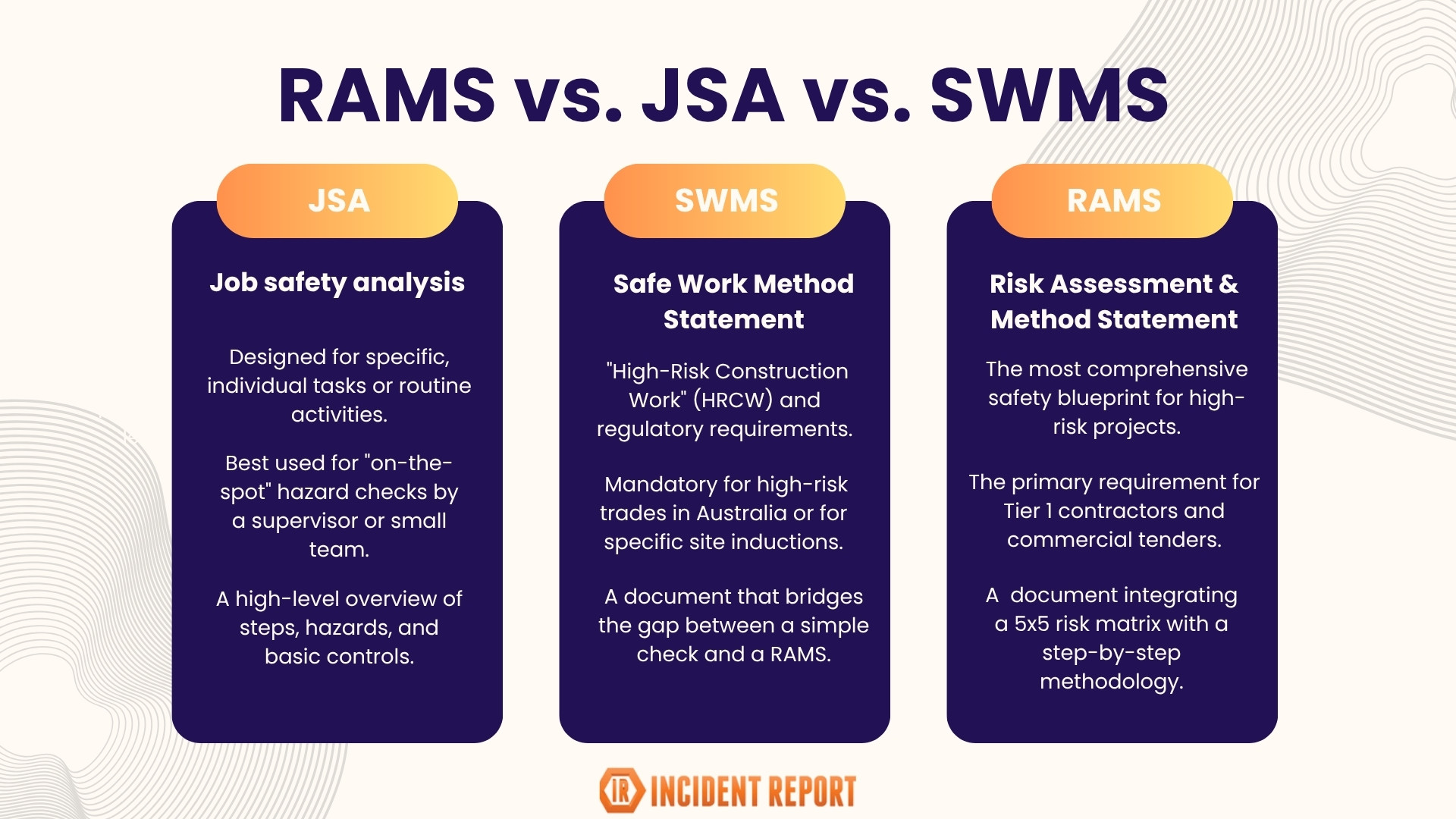
One of the biggest hurdles in safety compliance is the alphabet soup of acronyms. Depending on your region or industry, you might be asked for different documents. While a Job Safety Analysis (JSA) is often a task-specific, "on-the-spot" hazard check, a RAMS method statement is a much more detailed document usually required for high-risk projects.

In Australia, the Safe Work Method Statement (SWMS) is the standard, whereas RAMS is the dominant terminology in the UK and Europe. RAMS is generally considered the most detailed of these options, making it the preferred choice for Tier 1 contractors and high-value tenders.

View RAMS Method Statement Templates, Forms and Examples


Why RAMS is Critical for 2026 Compliance

The regulatory landscape increasingly demands "active" safety management. RAMS provides the documented evidence that you have identified task-specific hazards, consulted with the workforce on safety protocols, and communicated a clear Safe System of Work (SSOW) to all operatives.

Beyond legal requirements, RAMS are the "gold standard" for pre-qualification. Tier 1 contractors and insurance providers now view digital, site-specific RAMS as a key indicator of a company's safety maturity. If your RIR (Recordable Incident Rate) is your "scorecard," then your RAMS is the "game plan" you use to keep that score low.

The Shift to Digital RAMS Management

Manual RAMS creation often leads to "copy-paste" errors, outdated versions on-site, and a lack of real-time visibility. Transitioning to a digital safety management platform transforms RAMS from a static document into a dynamic asset.

Digital RAMS Boosts Business Value through:
  • Version Control & Standardization: Ensure every site is using the most current, approved version of a method statement. Updates are pushed instantly to all mobile devices.
  • Real-Time Mobile Sign-off: Workers can review and sign the RAMS directly on their phones or tablets. This captures a defensible audit trail of exactly who was briefed and when.
  • Rich Media Integration: Digital RAMS allow you to embed site photos, diagrams, and video briefings, making the instructions clearer for teams with diverse language or literacy levels.
  • Automated Workflows: Upon the completion of a Risk Assessment, the system can automatically flag "High Risk" tasks for management review before the Method Statement can be issued.

Key Data Elements for Digital RAMS

To ensure high-quality data and compliance, your digital RAMS should capture these essential elements:

Identification Details: Date, time, specific work location (ideally GPS tagged), and the project manager in charge.
Risk Calculation: Numerical scoring of Likelihood vs. Severity to determine the residual risk score.
Personnel & Training: A list of required competencies (e.g., CSCS, First Aid, IPAF) required for the task.
Step-by-Step Methodology: A clear, factual narrative of the work sequence, from site arrival to final clearance.
Equipment & PPE: Required fields for specific safety gear, such as Level 3 cut-resistant gloves or P3 respirators.
Emergency & First Aid: Specific rescue plans for high-risk work, such as working at height or in confined spaces.

Best Practices for Optimizing Your RAMS Process

Transitioning to a digital RAMS system requires a focused strategy to ensure regulatory accuracy and high user adoption.

1. Avoid the "Copy-Paste" Trap While templates save time, every RAMS must be site-specific. Use a digital builder that allows you to easily toggle site-specific hazards. A "templated" RAMS that doesn't mention the specific hazards of your job site is often viewed as a major compliance red flag by auditors.

2. Implement Mobile-First Design Prioritize the field experience. Your RAMS software must be intuitive on mobile devices. Use smart features like dropdown menus, required fields for critical data, and e-signatures to ensure that the document is actually read and understood at the "point of work."

3. Integrate Automated Workflows Digital RAMS should not be data silos. Upon submission, the document should automatically trigger the next required action. For instance, a submitted RAMS for a high-risk demolition task should immediately notify the Safety Director for final approval before the site team can begin.

4. Ensure Unambiguous Version Control Working from outdated methods is a major liability. Digital systems guarantee that all users are accessing and using the most current, compliant version of every RAMS, deploying updates instantly and universally across the organization.

The Pathway to a Proactive Safety Culture

Mastering the RAMS method statement is about more than just avoiding fines; it’s about building a culture where safety and operational efficiency are the same thing. By digitizing your RAMS, you reduce administrative friction, empower your field teams, and provide your clients with the transparency they demand in 2026.

Modernize your safety documentation today.

THE FUTURE OF
INCIDENT REPORTING SOFTWARE

Hit the ground running with all our Incident Report form templates and registries or create / load up your own

Mobile Incident Reports so that staff can access and report from the field / while on site from their phone or tablet

Best RAMS method statement design tools

Using our RAMS method statement form builder, you can create any type of report form and generate a matching registry. Enable your staff to record incidents in the field and from their phones or tablets replacing traditional paper based or draconian style processes. Get Started for Free

Get Started Free
Create your first Incident Report form or choose from our form templates and start recording incidents in the field