


SAFETY OBSERVATION REPORT

The Ultimate Guide to Recordable Incident Rate: Benchmarking Safety Excellence

Published 04/17/2026

In the competitive landscape of modern industry, safety isn't just a moral imperative, it's a business metric that can make or break your bottom line. At the heart of this metric lies the recordable incident rate (RIR).

To the uninitiated, it's just a number. To a Safety Director, it's a reflection of company culture, operational efficiency, and financial health. In this comprehensive guide, we will explore the nuances of RIR, how to calculate it accurately, and how digital transformation is changing the way we manage workplace safety.

View Recordable Incident Rate Examples, Creation Tools and Samples

What Exactly is a Recordable Incident Rate?

The Recordable Incident Rate, also known as the Total Recordable Incident Rate (TRIR), is a standard calculation used by OSHA to determine how many work-related injuries and illnesses occur within a company relative to the total hours worked.

The Definition of "Recordable"

Before you can calculate your rate, you must identify what counts as a "recordable" event. According to OSHA (specifically 29 CFR Part 1904), an incident is recordable if it results in:
  • Death
  • Days away from work
  • Restricted work or transfer to another job
  • Medical treatment beyond first aid
  • Loss of consciousness
  • A significant injury or illness diagnosed by a physician or licensed health care professional

Note: "First Aid" (e.g., using non-prescription meds at non-prescription strength, cleaning minor wounds, or using finger guards) is specifically excluded from RIR calculations.

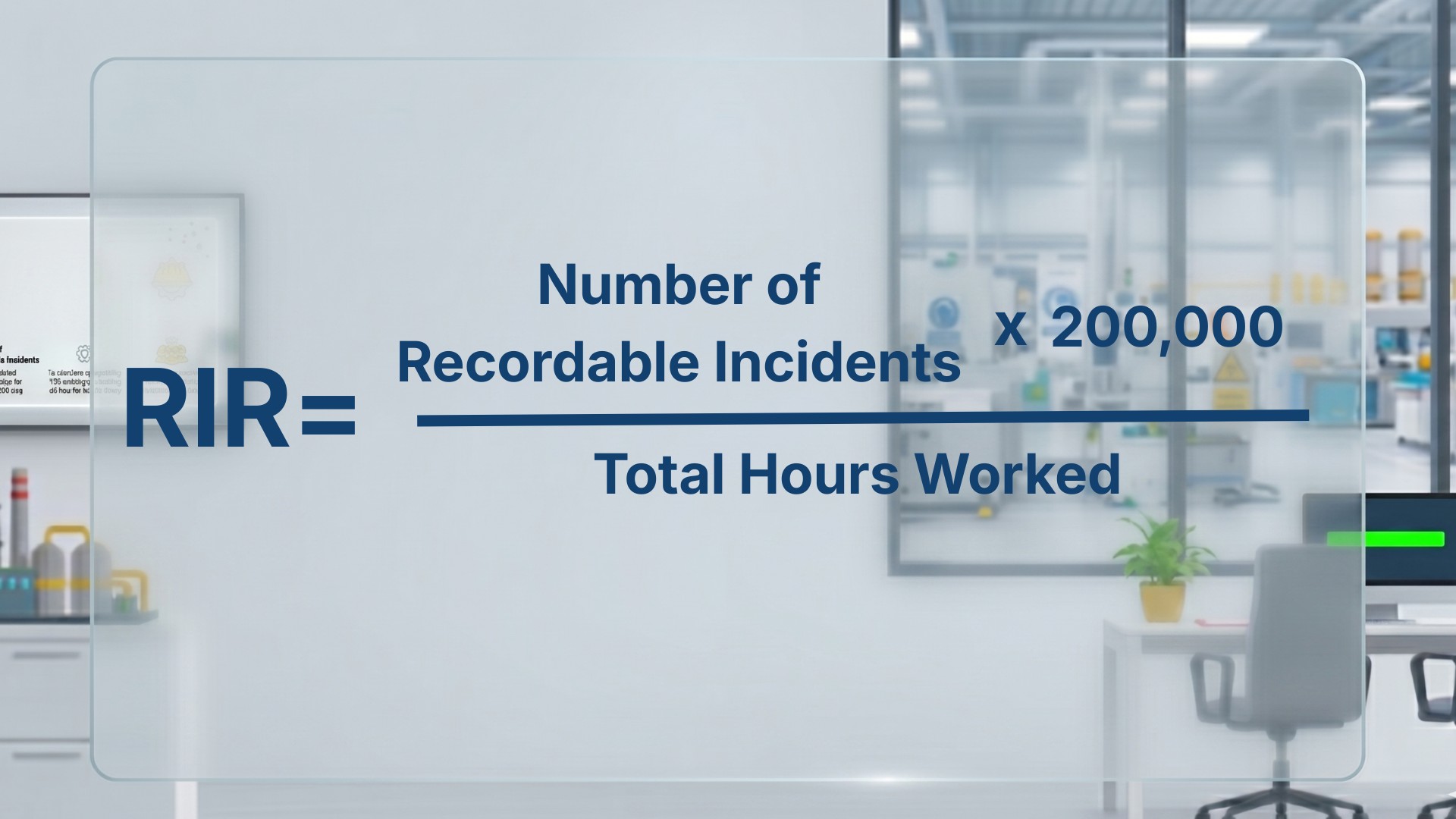
The Math Behind the Metric: The RIR Formula

OSHA uses a standardized base of 100 full-time workers to ensure that a company with 10 employees can be compared fairly against a corporation with 10,000.


The Formula:

RIR=
Total Hours Worked by All Employees
------------------------------------------------
(Total Number of Recordable Cases x 200,000)
Breaking Down the Variables:
  • Total Number of Recordable Cases: This is the sum of all incidents listed on your OSHA 300 Log.
  • 200,000: This represents the number of hours 100 employees would work in a year (100 workers x 40 hours/week x 50 weeks/year).
  • Total Hours Worked: This must be the actual hours worked by all employees, including overtime. It should not include vacation, sick leave, or holidays.


  • Discover our Recordable Incident Rate module


    Why Your RIR is More Than Just a Compliance Check

    If you think the recordable incident rate is only for OSHA's benefit, you're missing the bigger picture. This number ripples through every facet of your business:

    1. The Financial Impact (The "Hidden" Costs)

    While a recordable incident has direct costs (medical bills, legal fees), the indirect costs are often 4x to 10x higher. A high RIR leads to:
    Increased Workers' Comp Premiums: Insurance companies use your RIR and EMR (Experience Modification Rate) to determine your risk level.
    Legal Liability: High rates can be used as evidence of negligence in personal injury lawsuits.

    2. Competitive Advantage and Bidding

    In industries like construction, manufacturing, and energy, your RIR is a key part of the "pre-qualification" process. Many clients set a maximum RIR threshold (often 3.0 or lower). If your rate is too high, you are automatically disqualified from bidding on major contracts.

    3. Recruitment and Retention

    In the "war for talent," safety is a selling point. Skilled workers want to know they are entering an environment that prioritizes their well-being. A transparently low RIR is a powerful recruitment tool.

    View Recordable Incident Rate Templates, Forms and Examples


    What is a "Good" Recordable Incident Rate?

    A "good" rate is relative to your industry. For example, a software company will naturally have a lower RIR than a steel mill. To understand your performance, you should compare your rate against the Bureau of Labor Statistics (BLS) annual industry averages.

    Top Performers: Usually maintain an RIR 50% lower than their industry average. The Goal: The ultimate goal is always "Zero Harm," but a steady downward trend is the most realistic indicator of a healthy safety program.

    Moving Beyond the Number: How to Lower Your RIR

    If your recordable incident rate is climbing, it's time to move from reactive firefighting to proactive management.

    Implement Modern Incident Report Software The greatest enemy of a low RIR is bad data. If incidents aren't reported immediately, you lose the ability to intervene. Digital tools allow for:
    • Real-time reporting: Capture photos and GPS data of a hazard before an injury occurs.
    • Automated OSHA Logging: Eliminate the "end-of-year scramble" by keeping your OSHA 300, 300A, and 301 forms updated in real-time.
    • Trend Analysis: Identify "hot zones" in your facility where incidents are clustered.

    Focus on "Near-Miss" Reporting

    A near-miss is a gift- it's a free lesson. For every recordable injury, there are typically dozens of near-misses. By encouraging a culture where workers feel safe reporting near-misses without fear of retribution, you can fix the root cause before a "recordable" ever happens.

    Continuous Training and Micro-learning

    Safety training shouldn't happen once a year. Regular "toolbox talks" and digital micro-learning modules keep safety protocols top-of-mind, reducing the human error that leads to recordable events.

    Future-Proof Your Safety Strategy

    Your recordable incident rate is a window into the soul of your operations. While it is a lagging indicator, the way you manage it defines your future success. By leveraging incident report software, fostering a culture of transparency, and obsessing over the "why" behind the numbers, you don't just stay compliant- you become a leader in your industry.

    Is your data working for you or against you?

    Discover how Incidentreport.net simplifies OSHA compliance and provides the insights you need to drive your incident rate toward zero.

THE FUTURE OF
INCIDENT REPORTING SOFTWARE

Hit the ground running with all our Incident Report form templates and registries or create / load up your own

Mobile Incident Reports so that staff can access and report from the field / while on site from their phone or tablet

Best Safety Observation design tools

Using our safety observation form builder, you can create any type of report form and generate a matching registry. Enable your staff to record incidents in the field and from their phones or tablets replacing traditional paper based or draconian style processes. Get Started for Free

Get Started Free
Create your first Incident Report form or choose from our form templates and start recording incidents in the field